The Key West Scene

I have detailed many of the cultural, literary, film, and musical “scenes” from the past. They are important because they often spawn deep seismic sociological, political, and artistic shifts within society at large. Sometimes, it takes decades to realize the full impact of what actually took place and the influence imparted. Some scenes pick up steam and become a movement such as the early 20th century Modernist Movement in American poetry. At about the same time, the Algonquin Round Table in New York boasted such literary and theatrical figures such as Dorothy Parker, George S. Kaufman, Robert Benchley, Harpo Marx, Harold Ross, and Tallulah Bankhead. In Paris, literary heavyweights Ernest Hemingway, F. Scott Fitzgerald, Gertrude Stein, and James Joyce gathered for drink and literary endeavors. Greenwich Village was the home to two important scenes in the 1950’s and 60’s – the Beats and the folk music revival. Who wouldn’t want to be part of those scenes?
One scene that escaped me, until I saw a recent documentary All That Is Sacred, is the Key West Scene of the late 60’s to the mid 70’s.
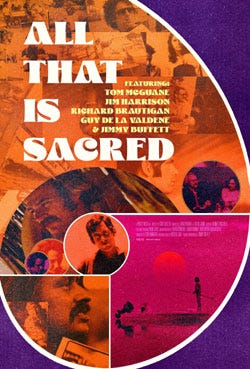
Writer Carl Hiassen, has said, “Having all of that talent in Key West, that was the equivalent of the Round Table at the Algonquin”. And that talent included writers Jim Harrison, Russell Chatham, Tom McGuane, Richard Brautigan, and musician Jimmy Buffett as well as the assorted hippies with a laissez faire attitude. In a sense, bohemians, pirates, writers, refugees and runaways were always drawn to Key West-before and after Ernest Hemingway made the island famous. Truman Capote, Tennessee Williams, and John Dos Passos also frequented Key West. But what bonded McGuane, Harrison, Brautigan, Buffett, and the others was their love of fishing and literature. They all achieved success very early in their careers. At one time, Brautigan who wrote Trout Fishing In America, was so famous that the Beatles were interested in meeting him.
The event that galvanized the Key West scene was the film Tarpon. In 1974, it centered on celebrity writers, Harrison, Brautigan, McGuane, and tarpon fishing. Tarpons are highly valued as a saltwater game fish, not only for their size but because of their fight and sensational leaping ability. Jimmy Buffett performed the soundtrack. But the film had issues with release and distribution. Rumors floated that the film was funded by drug smugglers. It has since become a cult classic due to bootlegged copies.
By the end of the 70’s, the Key West scene, like all scenes began to come to an end. There is no official ending, but its participants know when the gig is up. The scene got dark with harder drugs, more and more tourists, New York hipsters, and people mysteriously disappearing. McGuane, and Harrison moved out West and restarted their careers. Jimmy Buffett began his long journey to Margaritaville fame. Brautigan didn’t fare as well, he committed suicide with McGuane supplying the urn for his ashes. Buffet summarizing not only Key West, but all scenes said, “Everyplace I’ve been, someone says you should have been here ten years ago”. Just as pertinent would-be Barry McGuire’s answer to my question about the Laurel Canyon 60’s-70’s singer-songwriter scene. He replied by telling me, “The only way I can describe it, would be to pour a bucket of warm water on a water-colored painting, whip the painting around your head a half a dozen times, and then what you would see would be my memories of that ten-year period. What more can I say”?